X

I'm here to help you discover how our Agentic platform can boost your revenue, enhance the guest experience, or save your staff time on manual tasks.



Try booking your own experience on your phone as if you’ve never been there before.
You land on a ticketing page and immediately have to work for it. There are multiple ticket types, overlapping promotions, and just enough information to make you hesitate, but not enough to make you confident. You start asking normal questions: What’s actually available today? Which one is worth it? Is this right for me?
And there’s no answer at that moment. So you leave.
That’s what’s happening every day across attractions and tour operator websites. Not because demand isn’t there, but because the experience expects guests to figure everything out on their own.
From the business side, it shows up as a familiar pattern: strong traffic, weak conversion, and high-value inventory that only sells when a human gets involved. The gap between browsing and booking is still too wide.
And that gap isn’t solved by adding another FAQ or a generic chatbot. It’s solved by introducing something new into the experience, something with a clear job to do.
Most AI chat tools are built to answer questions. A Ticketing Agent is built to sell tickets. That's the difference that matters for attractions and day tour operators.
Think of it as the most knowledgeable rep who knows your full catalog, can recommend, can compare, and can close, running 24/7 in the channel guests already use: chat.
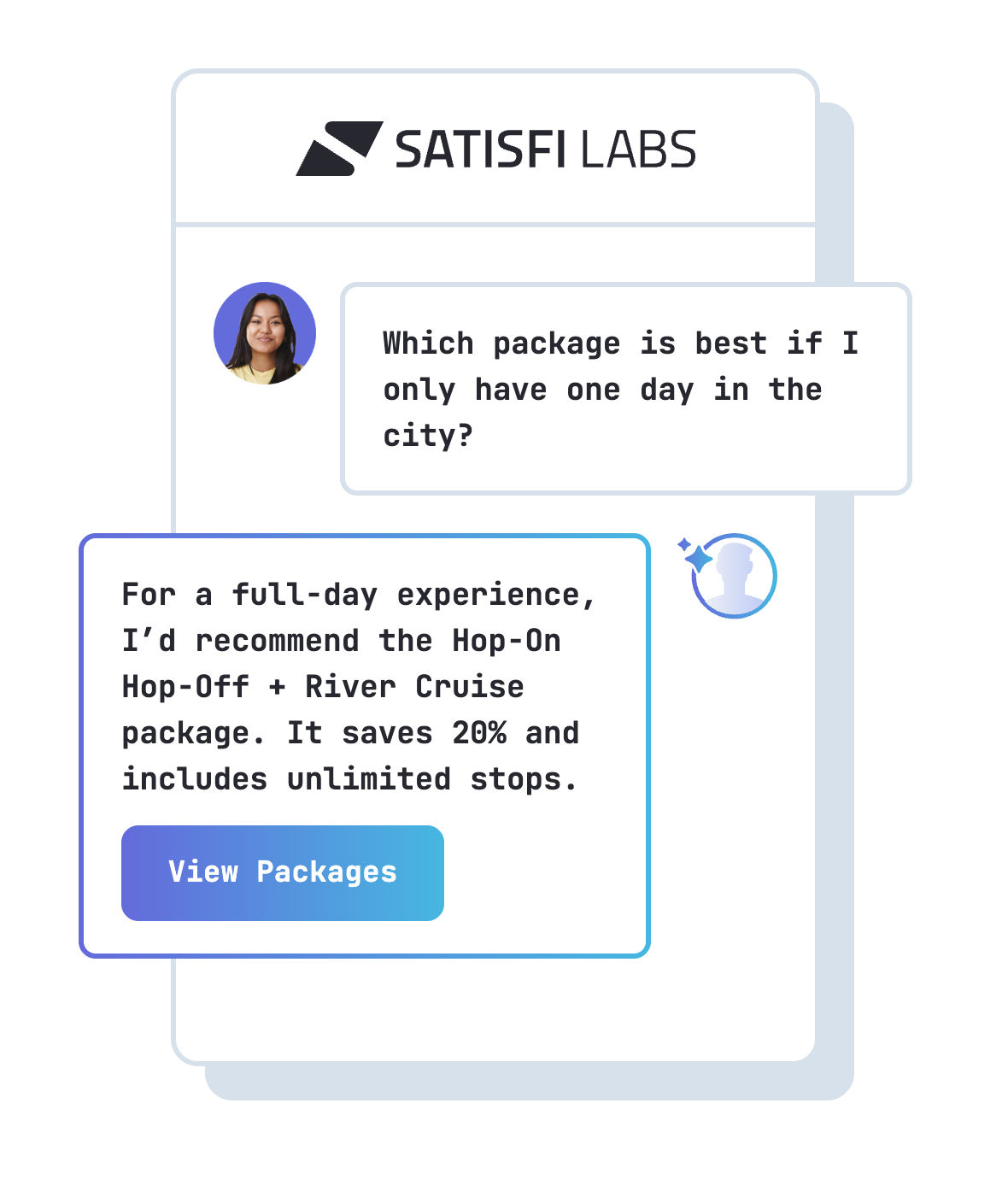
To do that job, the agent has four core capabilities.
Attractions & tour operator inventory is layered, time-bound, and decision-heavy. Tours, packages, hospitality add-ons, family bundles, premium experiences: all priced differently, all hard to compare on a phone. And tourism traffic skews mobile, last-minute, and emotional ("we're walking past this thing right now, should we go in?").
A Ticketing Agent meets all three constraints at once.
Layered inventory becomes a conversation instead of a catalog. A guest doesn't read your full menu, they ask "what's worth doing this afternoon with two kids?" and get a real answer.
Last-minute decisions become bookable in the same window the guest is asking. "Is the 2pm bus tour sold out?" "If we leave the museum at 4, can we still make the harbor cruise tonight?" These are situational, time-sensitive questions a static page can't handle. Live inventory plus conversation can.
Mobile becomes a primary revenue channel. The friction of cross-tab comparison shopping disappears, and so does the dropoff that comes with it. At City Sightseeing New Orleans, 90% of ticket discovery and purchases happened on mobile once a Ticketing Agent was in place.
Web stops handing off undecided guests. Instead of routing them to a checkout that loses them, the agent closes them in chat. At City Sightseeing New Orleans, in-chat conversion from search to sale ran at 20%, with 2.5 tickets per transaction, and is projected to drive over $70K in incremental ticket sales in 2026, with no new traffic and no new paid acquisition.
A Ticketing Agent isn't trapped on your homepage. It runs equally well on desktop, on mobile, and inside the channel tourism brands consistently miss the most: on-the-ground, situational traffic.
Print a QR code on a bus-stop sign, a sidewalk poster, an attraction queue marker, a flyer at the airport. A tourist walking past, already curious, already in the moment, scans, opens the chat on their phone, and starts asking real questions: "Is the walking tour worth it?" "Can we still buy tickets for tonight?"
That's a visitor you would never have captured through paid acquisition or organic search. They're not at home browsing. They're standing in front of your sign with their phone out. Web and mobile capture the guest who searched. QR captures the guest who showed up.

Those capabilities don't all need to launch at once. We package them as two campaigns, each closing a different leak in the funnel.
Enhanced Ticket Discovery turns your website into a conversational ticket desk. The agent answers “what’s on?” while helping guests discover the right tours, packages, and pricing in one conversation. But it goes far beyond a website chatbot. The agent pulls from multiple data sources, including schedules, premium offerings, accessibility programs, group policies, internal documents, and partner feeds, so it understands the full experience, not just the homepage.
That means guests get richer answers to the questions that usually slow down a purchase, especially on mobile, helping them book with more confidence.
Convert Ticket Discovery is where the agent connects to live Ventrata inventory and closes the sale inside the conversation. Real-time availability, real-time pricing, real-time checkout.

You can run one campaign on its own. With Ventrata integration in place, you can also bundle campaigns to cover both core jobs: answering ticket questions and closing the sale inside the chat.
A Ticketing Agent isn't a feature you bolt onto a site. It's a role you hire: with a clear job (sell tickets), campaigns it is running that have goals and measurable key results, a defined toolkit, and a 24/7 shift in the channel guests already use.
For attraction & tour operator brands the bet is simple. A guest who gets a real answer in the moment is a guest who books. Conversation is the channel. The agent is the closer.


